
Practice Point: Viloma Pranayama (Stepped Breath)
As the seasons transition towards Autumn, it can be a time of change and uncertainty, and a good opportunity to focus on grounding and balancing practices. In Traditional Chinese Medicine, Autumn is associated with the lungs. During this season, I like to introduce viloma pranayama, a breathing practice that can help expand lung capacity and gently strengthen the lungs as we move into the colder months.
Viloma means “against the grain” or “against the natural order.” Instead of breathing in one smooth inhale or exhale, we pause along the way. For this reason, it is often referred to as stepped breathing.
Some people find it helpful to imagine moving up and down a building in an elevator, stopping briefly at different floors before continuing the journey. Another image I sometimes use is a snowy mountain: we might take the chair lift all the way to the top, or step up the mountain in stages. At the top we pause to enjoy the view, and then come down again — either stepping down the mountain or skiing smoothly all the way to the bottom.
Before you begin
Pausing the breath creates pressure shifts and carbon dioxide buildup, adding demand on your heart and lungs.
Seek medical advice first if you have the following conditions:
Asthma
Heart conditions
Unmedicated high or low blood pressure
Vertigo
Also seek medical advice if you are pregnant or simply unsure whether this practice is right for you.
Respiratory muscles tire like any other muscles, so practise gently. If at any time you feel dizzy or uncomfortable, stop the practice and return to your natural breathing.
The practice
Start in a comfortable seated or kneeling position, either on the floor or in a chair.
Alternatively, lie down in shavasana on your back.
Posture is important. Choose a position that lets you breathe freely without restriction.
In this practice, we explore three variations:
Stepped inhalation
Start with some calming, releasing breaths—breathing in and out naturally, completely filling and emptying the lungs.
You might like to imagine that your lungs are divided into thirds from the bottom to the top.
- Inhale into the bottom third and pause briefly.
Think of this pause as a gentle suspension of the breath, not a hard stop.
- Inhale into the middle third and pause briefly.
- Inhale to fill the lungs completely, and then exhale in one long breath.
Repeat the stepped inhalation for 3–5 rounds, then return to your natural breathing.
Note: Adjust the number of stops so the practice stays manageable and steady for you.
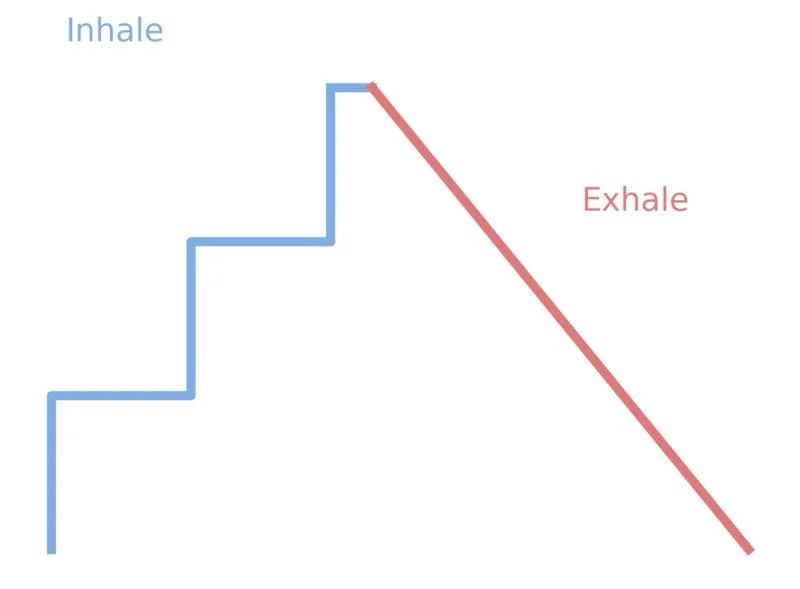
Stepped inhalation with pauses, followed by one smooth exhalation.
Stepped exhalation
Start with some calming, releasing breaths—breathing in and out naturally, completely filling and emptying the lungs.
- Inhale fully to fill your lungs.
- Exhale about a third of the breath and pause briefly.
Think of this pause as a gentle suspension of the breath, not a hard stop.
- Exhale another third and pause briefly.
- Exhale completely, emptying your lungs.
Repeat the stepped exhalation for 3–5 rounds, then return to your natural breathing.
Note: Adjust the number of stops so the practice stays manageable and steady for you.
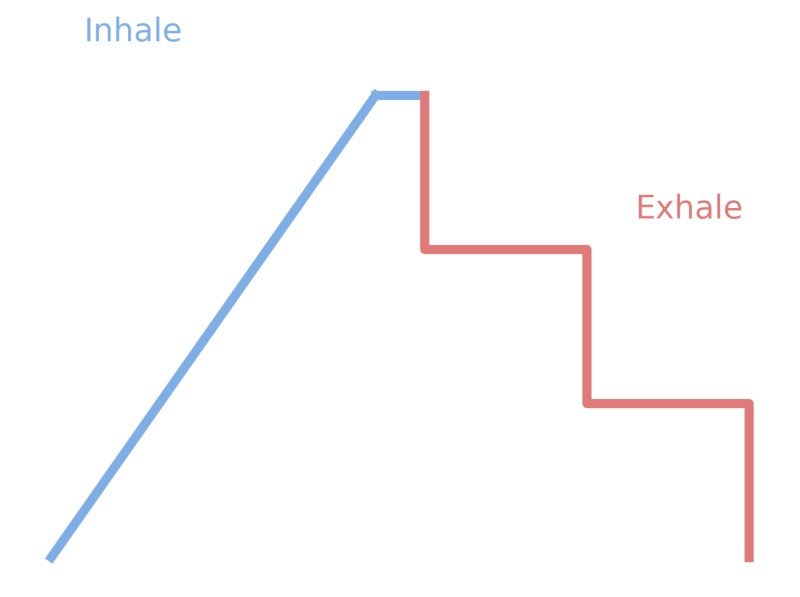
One smooth inhalation, followed by stepped exhalation with pauses
Stepped inhalation & exhalation
Start with some calming, releasing breaths—breathing in and out naturally, completely filling and emptying the lungs.
- Inhale into the bottom third of the lungs and pause briefly.
- Inhale into the middle third and pause briefly.
- Inhale to fill the lungs completely.
You might like to pause briefly here.
- Exhale about a third of the breath and pause briefly.
- Exhale another third and pause briefly.
- Exhale completely, emptying your lungs.
Repeat for 3–5 rounds, then return to your natural breathing.
Note: Adjust the number of stops so the practice stays manageable and steady for you.
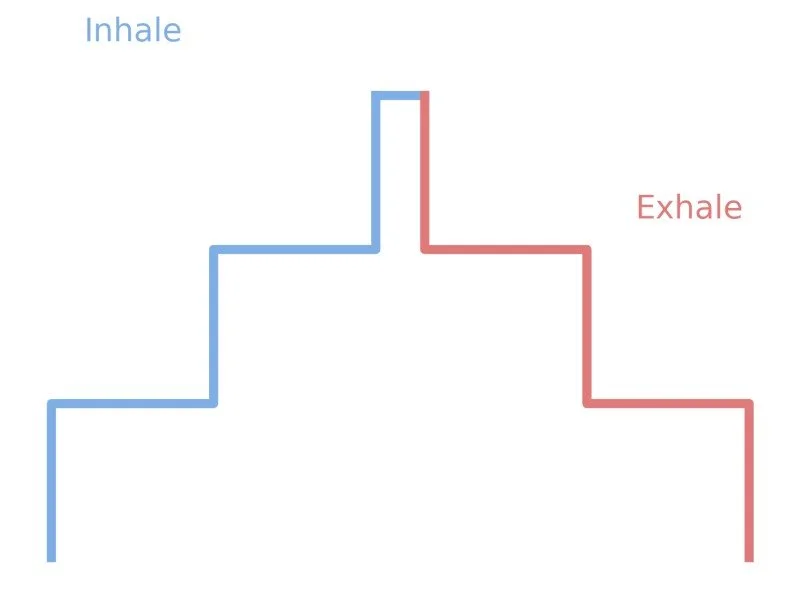
Stepped inhalation and exhalation with pauses
Benefits
Encourages greater awareness and control of the breath
Improves concentration, leading to greater mental clarity and focus
Helps train and strengthen the respiratory muscles
Can gradually increase lung capacity
Supports emotional balance
Stepped inhalation can feel calming and settling, and may help those experiencing anxiety
Stepped exhalation, or stepped inhalation & exhalation, can feel energising and may help counter lethargy or low mood
References
Viloma Pranayama, Tummee.com
Viloma Pranayama – 17 Wonderful Benefits and Contraindications, SeekHealthZ
Viloma Pranayama, The Ultimate Guide for Vitality, Sukhvinder Singh (Chaitanya), Yoga Chaitanya
Yoga for Your Mood Deck, Amy Weintraub